Aqarat Smart Real Estate CRM

Aqarat helps real estate teams capture leads, manage properties, track deals, and close faster — all from one centralized system.
Centralized CRM for Complete Real Estate Operations
Real estate businesses struggle with scattered data, manual tracking, and poor visibility across leads, properties, deals, and team activities. Using spreadsheets or disconnected tools causes missed follow-ups, slow deal closures, and operational confusion.
How we solve it
Centralized CRM for Complete Real Estate Operations
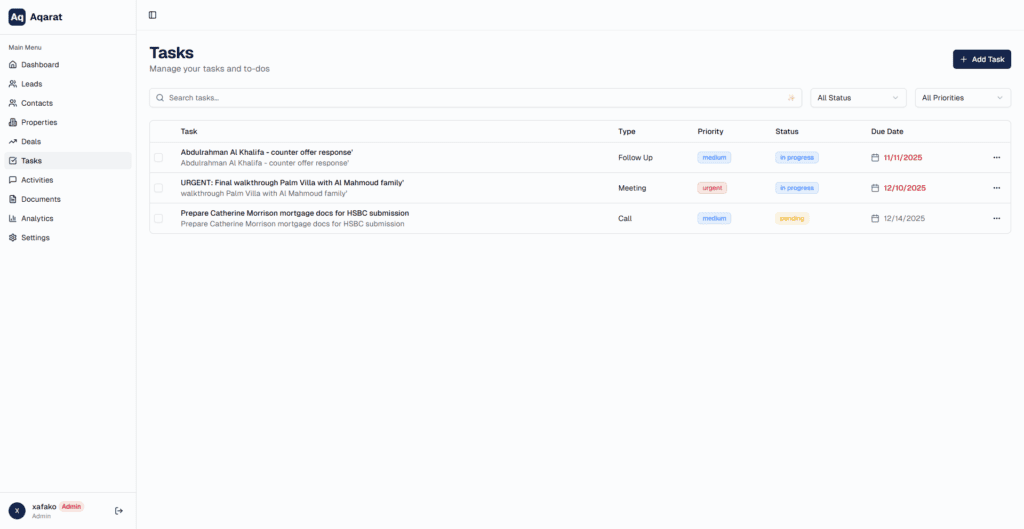
Aqarat solves these challenges by bringing leads, clients, properties, deals, tasks, and documents into a single, secure CRM platform. It replaces manual workflows with structured pipelines, real-time tracking, and role-based access, enabling teams to work faster and close deals more efficiently. From lead capture to deal closure — everything is tracked, organized, and measurable in one system.
Tech Stack
Project Process
Requirement Analysis
The project started by analyzing real estate business workflows, focusing on how leads are captured, followed up, converted, and closed. Common issues such as scattered data, manual tracking, missed follow-ups, and lack of visibility were identified. User roles, daily operations, reporting needs, and scalability requirements were documented. This phase defined core modules like Leads, Contacts, Properties, Deals, Tasks, Activities, and Documents, ensuring the system aligned with real operational pain points instead of generic CRM features.
System Architecture
A scalable architecture was designed separating frontend, backend, and database layers. The frontend uses Next.js with App Router for performance and maintainability. The backend follows a RESTful API structure using Node.js and Express. PostgreSQL was chosen for relational data consistency and performance. Authentication, authorization, file handling, and environment-based configuration were planned early to support future growth, security, and easy deployment across development and production environments.
UI Development
The user interface was designed to be clean, responsive, and workflow-driven. Dashboards were structured around daily actions such as lead follow-ups, deal progress, and task tracking. Tailwind CSS was used to maintain visual consistency and speed up development. Forms, tables, filters, and modals were optimized for real business usage, not just visuals. The UI focuses on clarity, reduced clicks, and quick access to critical information for sales teams and managers.
Backend Development
The backend was built using Node.js and Express to handle all business logic. REST APIs were developed for authentication, leads, contacts, properties, deals, tasks, activities, and documents. JWT-based authentication ensures secure access, while middleware handles validation, permissions, and error management. File uploads, pagination, filtering, and structured responses were implemented to support real-world usage. The backend was designed to be modular, making future feature additions straightforward.
Database Design
A relational database schema was carefully designed in PostgreSQL to handle complex CRM relationships. Tables were structured for leads, clients, properties, deals, tasks, activities, and documents with proper foreign keys and indexing. This ensures data integrity, fast queries, and accurate reporting. The schema supports scalability, allowing the system to handle growing data volumes without performance loss. Migration scripts were used to manage database changes in a controlled and repeatable way.
Integration & Testing
Frontend and backend were integrated using structured API endpoints with consistent request and response formats. Authentication flows, data creation, updates, filtering, and pagination were tested across all modules. Edge cases such as invalid input, permission restrictions, and file upload limits were handled. Manual testing ensured smooth user flows from lead capture to deal closure. This phase focused on stability, data accuracy, and ensuring the system behaves correctly under real usage scenarios.
Deployment
The frontend was deployed on Vercel for fast global delivery, while the backend was prepared for deployment on Railway or Heroku. Environment variables were configured for production security, including database connections and JWT secrets. PostgreSQL was hosted on a managed cloud service to ensure reliability. Build processes, migrations, and runtime configurations were validated to ensure smooth production operation. The deployment setup allows easy updates, scaling, and maintenance without disrupting users.
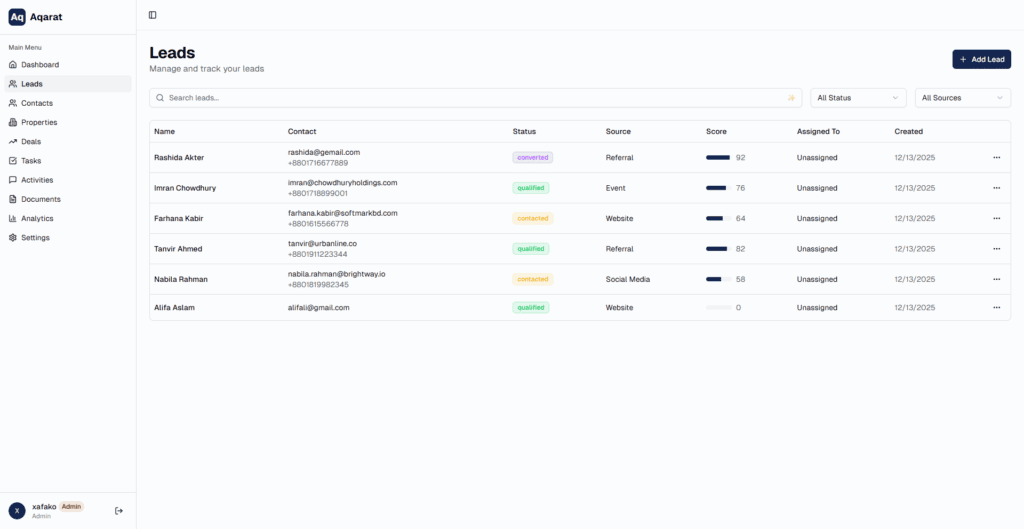
Lead Management
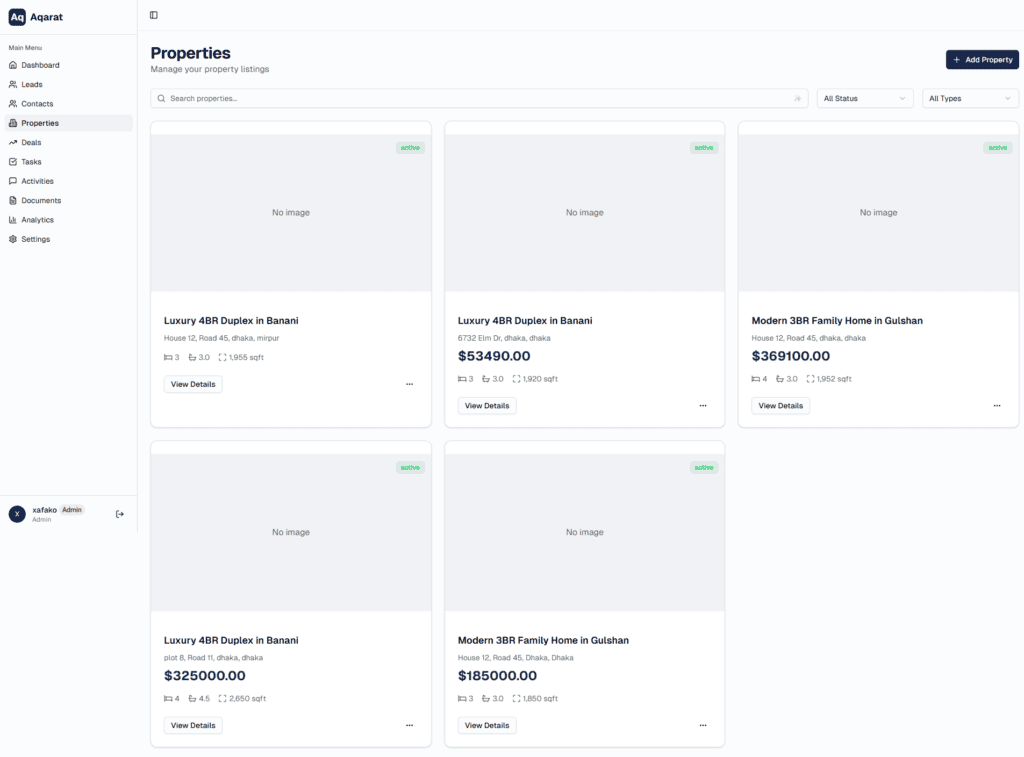
Property Management
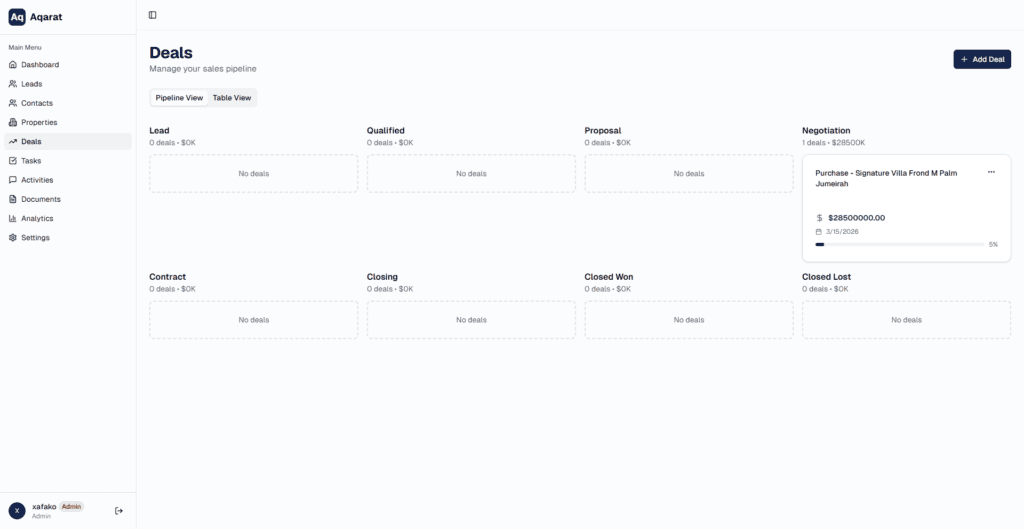
Deal Pipeline